
Ancient Parents: Awestruck and Frightful of their Children's Charts
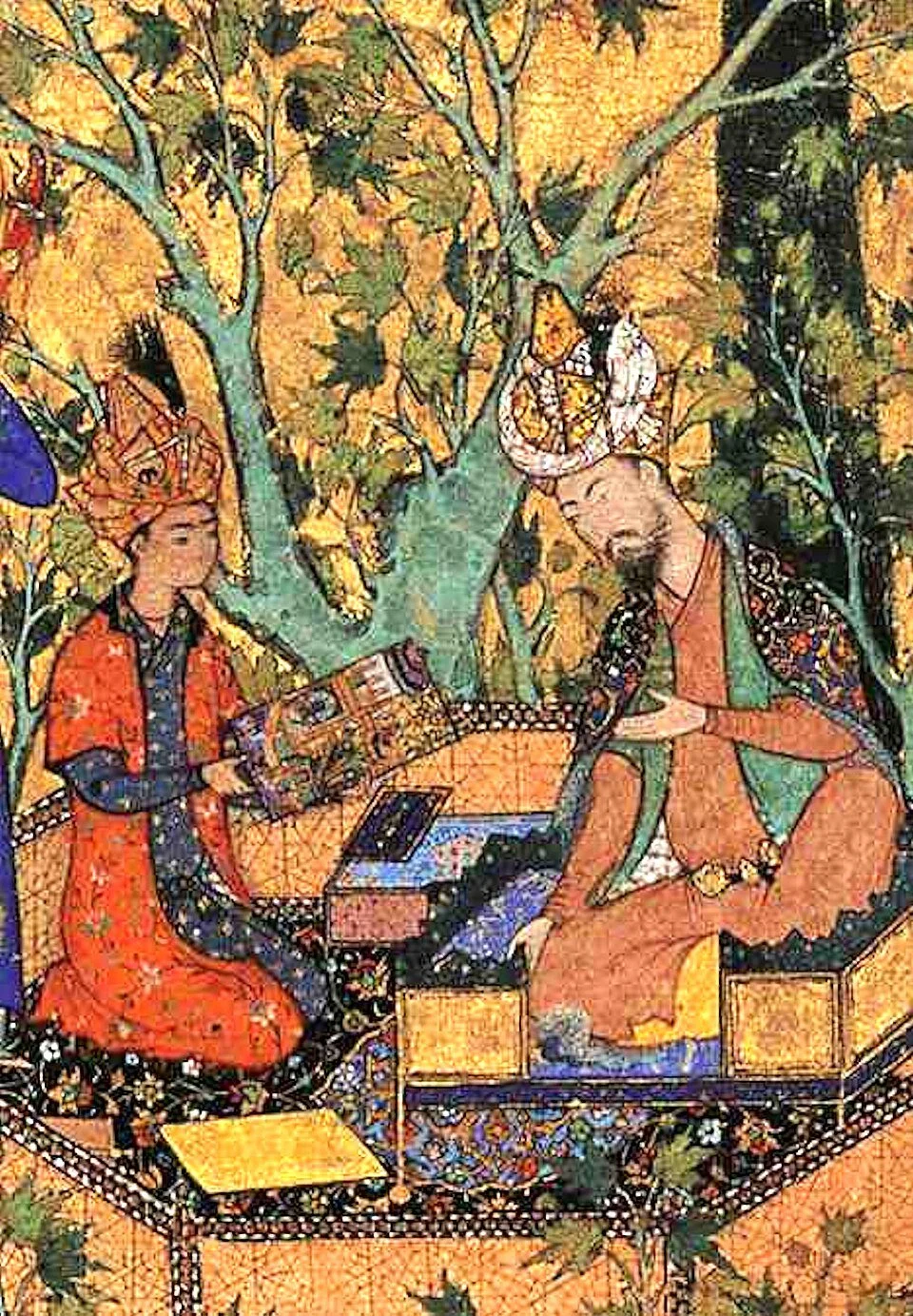
Akbar and Humayun portrait in Kabul (1550-56)
They were just like us…
After becoming a parent in 2020, the shape of my astrological practice began to quietly shift. Gradually, I began noticing an uptick of clients who were curious to learn more about their own children’s charts. Yet, a particular urgent request would begin to find my inbox on an increasingly regular basis: the nervous parent of a newborn child reaching out about concerning placements in their child’s chart.
“Help!” My baby has a 12th house stellium! Does that mean his father won’t be in his life?” “Help! My child’s Moon looks really rough – am I going to f*** them up???”
“Catherine, can you please help me make sense of my child’s super Saturnian chart?” “I’ve heard really horrible things about Pluto in the 8th house, and now it’s in my child’s chart... feeling nervous!”
“My child has Chiron in the first house, help!!”
I’d first like to point out that if this is you, you are completely normal. Without getting too deep into the nature of the post-partum brain, it’s very common for new parents to become hypervigilant of potential dangers which could impact their newborn’s ability to thrive. Cue the intrusive thoughts! Because you also love and care for your precious new baby, you are naturally going to be extra protective of them. For new parents, it makes sense that the detection of even the slightest potential difficulty in your baby’s natal chart could make you feel both protective and nervous.
One thing I like to remind parents is that the chunkier your baby gets, the less anxious you’ll become about their charts. And secondly, keep in mind that billions of people have led meaningful lives with imperfect charts (hint: there are no perfect charts). Third – your child is embarking on their own unique human experience; we cannot shield them from all the pitfalls of humanity, but we can love them unconditionally.
Having calculated my own children’s charts from the post-partum floor of the hospital, I’ve often marveled at this phenomenon. Astrology has become increasingly popular in the past decade. It makes so much sense that there would be a larger population of new parents out there who know just enough astrology to be dangerous, sending them into a midnight internet spiral fearing about their child’s placements – with those fears only to be confirmed by a cache of Reddit commentary faulting their natal placements for their plights.
For a while, I imagined this to be a unique phenomenon to the modern age. But recently I learned that this is not at all a modern phenomenon. In my latest research, I’ve uncovered fascinating stories capturing the very same struggles of parents from antiquity to the early modern period. In a moment, you’ll hear two contrasting stories of parents who both celebrated and bemoaned their child’s birth chart.
Before we dive in, just remember that these are stories. And while we do have primary sources for these accounts, they still were likely exaggerated a bit.
A Birth Chart Most Dreadful
Emperor Aulus Vitellius was one of four Roman Emperors who held office in 69 AD, the time known to historians as “The year of the four emperors.” Vitellius ruled from April through December of 69 AD. As you might imagine by his brief tenure, he wasn’t well liked.
Ancient Roman historian Suetonius wrote in The Twelve Caesars in 119 AD:
“Aulus Vitellius, the son of Lucius, was born on the eighth day before the calends of October […]. His parents were so aghast at his horoscope upon the calculation of his nativity by the astrologers, that his father tried his utmost, while he lived, to prevent [his son’s] assignment of any province; and when he was sent to the legions and hailed as emperor, his mother immediately mourned him as utterly ruined.”
Vitellius’ parents were mortified by his birth chart. Why exactly, we do not know. Though it seems that matters related to career or legacy were most concerning to them in his chart. So much so that they tried to prevent him from holding any kind of public office at all. We do not have a birth time for Vitellius, but a peep at his untimed birth chart allows me to exhale. Could it really be that bad? I would think some of his placements would be quite favorable. A Mercury cazimi in Virgo? Heck yeah, that’s amazing! Yet, the lens of ancient astrologers differed from ours. We would probably have to ask Dorotheus to comment.
As you might imagine, overhearing your parents whisper about your cursed birth chart might make you feel a certain way about astrology in general. Aulus Vitellius banished astrologers from Rome just months before he died. Right on cue, astrologers rebelled by posting their own decree:
“Take notice: the Chaldeans also decree that Vitellius Germanicus shall be no more, by the day of said calends.”
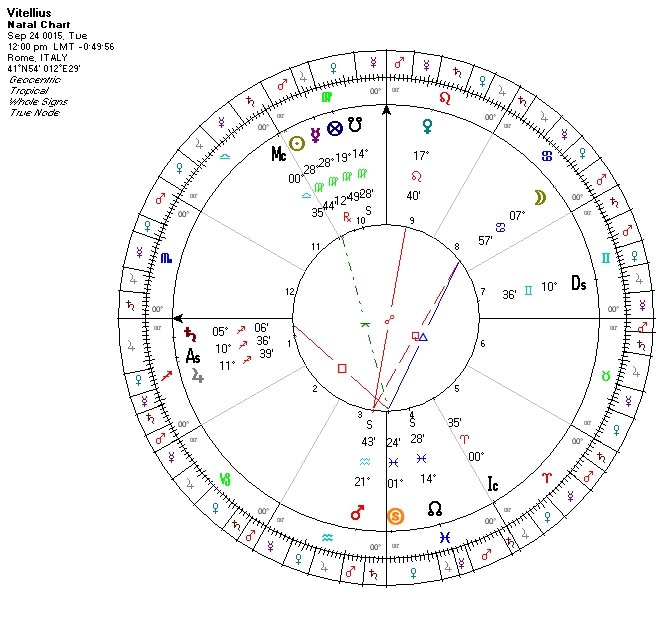
“Chaldean” originally referred to Babylonia but later became synonymous with astrologers. Here, the astrologers retort that he will no longer be their problem by the end of the year. The astrologers were correct. Vitellius was killed by Vespasian’s army before the end of the year. Vespasian, his successor, happened to hold a secret love for astrology, employing an astrologer by the name of Seleucus in his court.
While we don’t have the timed birth chart in front of us to confirm the conditions of Aulus Vitellius’ 10th house, we do know that he fulfilled his parents’ greatest fears. We can only imagine whether his fate was sealed by his own constellations or his parents’ self-fulfilling prophecy.
The Miraculous Birth Chart:
Humayun was once a disgraced Emperor of the Mughals, having lost his great empire in battle in 1540. Exiled from his kingdom, gravely in debt, without a home and on the verge of his own death, Humayun persisted in his aims to regain his empire. One thing which kept his spirit strong was his unwavering faith in the divine. Further, Humayun was obsessed with astrology – checking the stars before making every decision.
Praying to recover his losses, Humayun dreamt he would have a son (Akbar the Great) who would radiate with divinity and come to be one of the most legendary rulers the world had known. Two years later, Humayun’s wife Hamida Banu would near her due date. Given his involvement in political tensions, Humayun was forced to leave on business, but left his trusted astrologer, Maulana Chand to record his child’s ascendant and to calculate the natal chart at the precise moment of birth.
Now this is where it gets crazy. MJ Akbar, author of “After Me, Chaos: Astrology in the Mughal Empire,” writes that Maulana Chand tried to delay the birth as Hamida Banu labored(!!). He noted that if she held out for a couple more hours, the baby would be born with a rare and auspicious astrological alignment indicative of kings. The astrologer reportedly intervenes, scaring the laboring mother and stalling the birth of her baby (!!!!!!!!!!!). She falls asleep. Then Maulana Chand began to get nervous that the auspicious window would pass. Just as he was about to intervene *again,* she awoke to contractions and the radiant child Akbar was born!
Word was sent to Humayun with news of his newborn son and his regal birth chart. He rejoiced at his Mercury-Jupiter conjunction (the intelligence!), indications of a long reign and a powerful Mars, making him formidable in battle. Humayun perceived so much greatness in his son’s chart, he was convinced of his son’s divine destiny. He additionally saw *himself* in his child’s birth chart, undoubtedly wonderful things. All roads were golden and Humayun was convinced that the greatness of his child’s birth chart would indeed heal his own misfortune.
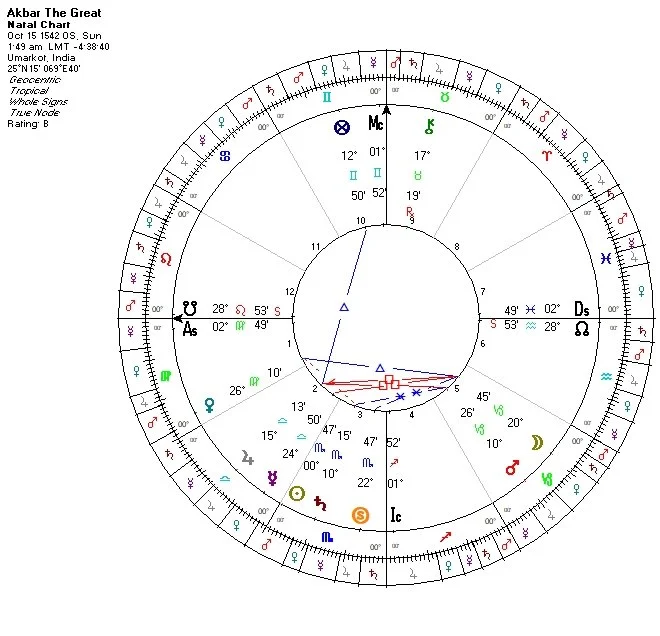
Against all odds, Humayun regained his empire and Akbar the Great would become the 3rd Mughal Emperor, one of the most famous and rulers of all time. Akbar is remembered for unifying a disjointed empire and cultivating common ground for the many different cultures and traditions under his rule. He was progressive, intelligent, a lover of the arts wisdom and beloved by many, yet a conqueror no less.
In this case, we do have a timed birth chart we can observe. Indeed, there are some wonderful placements in Akbar’s chart, but is it as miraculous as his father perceived? Hmmm, perhaps not. Was Akbar’s success and likeability shaped most by the fortune written in his stars, or by how much he was loved and encouraged within his early environment? Who knows.
Apart from contrasting these two stories, I am genuinely awestruck by Humayun’s idea that his fortune was influenced by his child’s birth chart. A common philosophical sentiment prevails beyond astrological theory alone: that our lives are changed by our children as they prepare to be born, or even in the very early years of their lives, making way for core elements of their destiny to take root. Further, it’s difficult to refute the interwoven nature of a child’s destiny with their parents’. Humayun insisted that his child’s birth chart would change his fate for the better. Miraculously, Humayun’s life tremendously recovered after the birth of his son. This account is an extraordinarily precious artifact for those fascinated in familial astrology.
In conclusion, like us, parents from antiquity also marveled and freaked at their children’s birth charts. Everyone is going to have some measure of objective favorability and difficulty in their birth charts, and our children are no different. But perhaps we can strive to be more like Akbar’s parents and remind our children that they are our greatest gifts - regardless of how favorable their birth chart appears.
Do you have questions about your baby’s chart too? My new service, “Baby’s First Astrology Reading” is designed for the astrologically savvy parent. This session holds space for new parents to inquire and learn about their new soul mate's astrological placements. Rather than offer detailed predictions, this is a space for openness, wonder and discovery as we aim to learn more about your little bundle of joy - and how to best support their unique needs as they grow up.
For more Family Astrology, check out my series, The Family Astrologer on YouTube
Big Blessings,
Catherine
References
Akbar, M. (2025). After Me, Chaos: Astrology in the Mughal Empire. Bloomsbury India: Bloomsbury Press.
Suetonius. (121). The Twelve Caesars. Rome.