
Saturn: Reincarnated Agricultural God
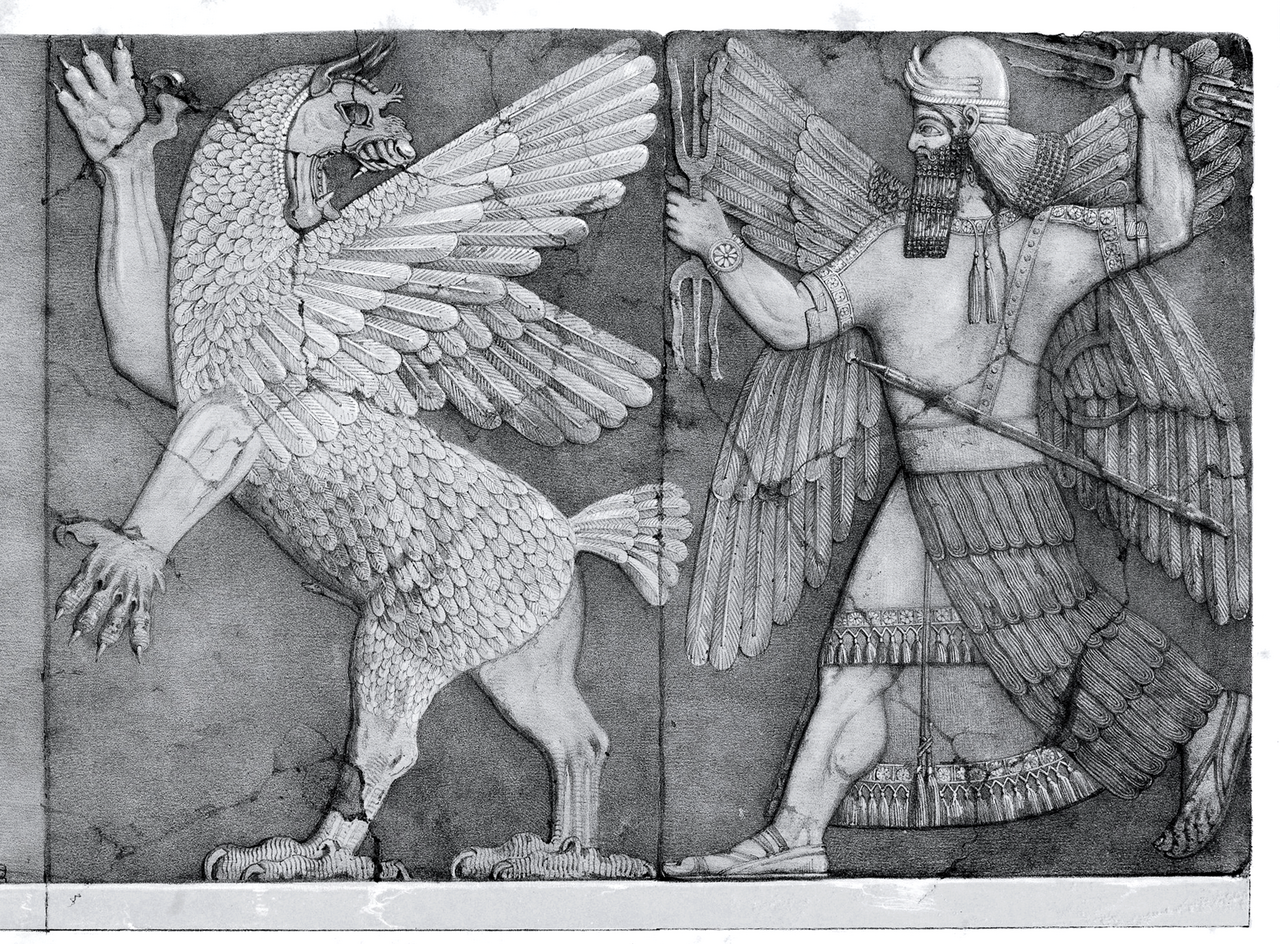
Stone carving depicting Ninurta’s pursuit of the Anzu; recovered from ancient Nineveh
It’s easy for new students of astrology to get it twisted. If Aquarius is an air sign, why does its name sound so… aqueous? Shouldn’t Aquarius, the water-bearer, be a water sign? Instead of an air sign?
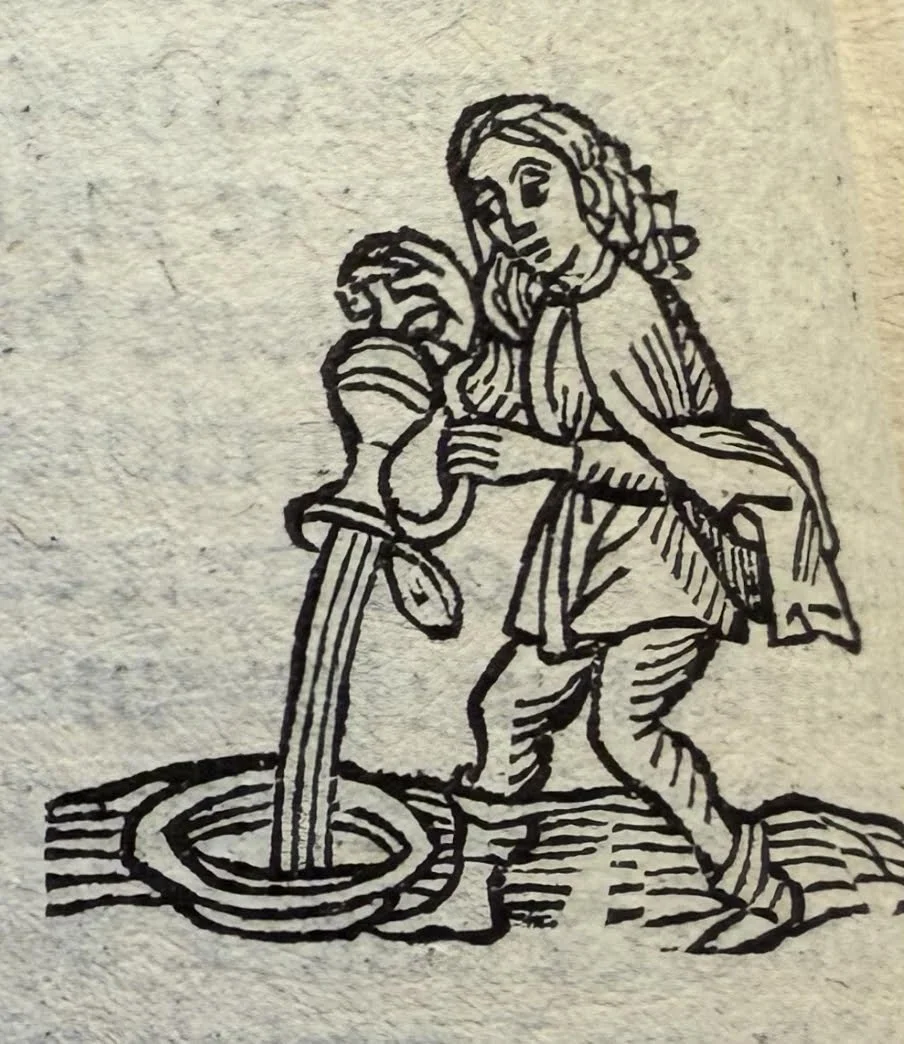
Aquarius from “Flowers of Abu Ma’shar,” printed by Ratdolt in Augsburg in 1488. First edition text handed personally at the Cleveland Public Library
Your astrology teacher will deny it. Aquarius is in fact a human sign, representing logic and reason. The urn? The water, or emotion, is contained and controlled. Aquarius tends to conceal their feelings, after all. The urn would represent technology to an ancient person. This aligns with what we are taught about Aquarius: that Aquarius is a sign of science, innovation and invention.
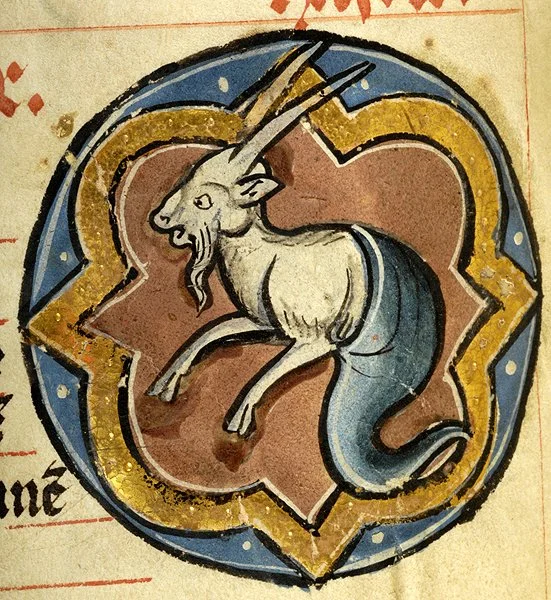
Capricorn, from the Morgan Library & Museum
Spend enough time ruminating on astrological fundamentals, and you will quickly learn to ignore Aquarius’ aqueous connection. It’s not a water sign, after all. And anyone who thinks otherwise is simply ignorant. But if you look a little deeper, you will continue to find more evidence of water in this section of the sky.
Aquarius and Capricorn are traditionally ruled by the planet Saturn. In astrology, Saturn is the planet of order, boundaries, maturity, limitation, time. solitude and darkness. Saturn is a malefic planet, or rather, a planet which pushes us through the depths of life’s challenges toward the hard-earned gems of wisdom. Saturn is hard. Like a rock. Or better yet, heavy as lead, which Saturn rules. Saturn reminds us that the things we will feel most proud of in our lives are the things we strove for.
Ptolemy tells us that Saturn is a cold and dry planet. A solitary, or even lonely and brittle planet. It’s objective, shrewd and discerning. Why then, do both of its signs of domicile, Capricorn and Aquarius, share elements of emotive water in their imagery?
Earthy Capricorn is not just a mountain goat. It is a sea goat.
Aquarius may be a human sign, but it’s distributing water from its urn.
To understand this paradox, we need to explore the divine hierarchies preceding the Olympians. Namely, the Sumerian and Babylonian Ninurta, Saturn’s predecessor.
According to myth, Ninurta was born to the Sky God Enlil. Enlil shared a tripartite rulership with Anu and Ea. Great Anu governed the Heavens, and Ea/Enki, ruled the waters. Enlil ruled over the region between the earth and the stars, most notably ruled the air, the winds and even storms. By extension, Enlil’s great and powerful son Ninurta would become a god of the rains. Often depicted as a raincloud, Ninurta was celebrated in the spring at the start of plowing season. Ninurta was associated with the plow, the hoe, the fertile rains and even agriculture itself. One Sumerian tablet known as The Farmer’s Instructions is dedicated to Ninurta. Another myth, Ninurta’s journey to Eridu, gives Ninurta the epithet, “Enlil’s faithful farmer,” and “the divine tiller.”[1]
Mesopotamian depiction of an ancient plow
Ninurta’s lore is vast, as evidenced by dozens of ancient stories depicting him as both as farmer and fierce warrior. Like Kronos, Saturn is often depicted with a sickle – a tool useful for both farming and warfare.
In the epic, Lugal-e, or the Exploits of Ninurta[2], the stones grow tired of their assigned duties and rebel against him. Ninurta frees the waters trapped in the mountains by a demon so that he may irrigate the Mesopotamian plains and restore the waters of the Tigris river – but the waters must be released in a controlled way to prevent disastrous flooding. In the myth, he delegates duties to all the minerals and stones. Here, we see Ninurta as the lord of irrigation, of structures, of stones, but also, as an authority and symbol of civilization. Here he receives yet another epithet as “the lord who has turned back the fierce waters.” Or even more popular at the time, “Ninurta is my shelter.” Ninurta is then associated with having dominion over stones. Demetra George[3] points out that we see a continuity with stone symbolism in the myth of Kronos, who is later tricked by his consort Rhea into swallowing a stone.
Nowadays, we might associate Saturn with structures. Protective structures. In the modern world, it’s easy to forget how fragile life once was (still is), and how something like irrigation could serve as a protective structure (truly, life or death). With Nergal’s mythology as the lord of irrigation and agriculture, it’s easy to see why Saturn exalts in Libra. Libra is another human, or air sign, representing social balance and order, law and civilization. Irrigation is a true symbol of human progress, evolving humans from hunter-gatherer species into developed agricultural societies.
It’s easy to see then, how Aquarius, a sign of science and knowledge would be depicted as a man containing and directing the waters. The emphasis is not on the water itself, but upon the direction of it.
Kronos, Kumarbi and the Sickle
Homeric author Hesiod recounts the lineage of the Olympian Gods in Theogony[4], written from Mt. Helicon between 700-730 BCE. At this time, in a land not too far away, ancient Assyrian priests began sitting atop their ziggurats for their nightly watch. By this time, it’s evidenced that elements of Sumerian and Hittite culture, including their myths, began to reach the lands of ancient Greece. Part of this evidence lives through Hesiod’s body of work – in particular, Ninurta’s reincarnation as the Titan Kronos.
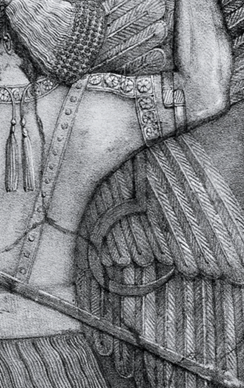
Close-up of Ninurta’s sickle
Kronos is born from the union of Gaia, the Earth, and Ouranos, the God of the Heavens. Every night Ouranos draped himself over her earthly body. Hesiod tells us that this was not a union of love. Instead, we infer this nightly ritual as unwelcome and forceful. Gaia devises a plan to resist. “Without delay, she created the element of gray adamant –” Essentially, she creates metal, an element certainly created by the earth. She fashions “a great reaping hook,” and presents it to her children, pleading for vengeance upon their father for his “ugly behavior.”
Gaia’s son Kronos takes courage to help her avenge her oppressor, quite like the courageous temperament of warrior-agricultural-god, Ninurta.
“Great Heaven came, bringing on the night, and, desirous of love, he spread himself over the Earth, stretched out in every direction.” Kronos stood ready with his “sharp toothed sickle” and severed his father’s member.
While Ninurta does not appear to castrate his sky-ruling father, a neighboring agricultural god does. Kumarbi of the Hurrian civilization (~1500 BCE) pulls down the Sky God, Anu, down by biting his ankles (Aquarius rules the ankles!) and castrates sky god with his teeth (and swallows, eek!). Before narrowly escaping into the sky, Anu tells Kumarbi that he is now pregnant with his three children. Kumarbi quickly spits one of the children out, but now the issue becomes how the remaining children will be born. The Fates decide that they will be born from his skull (Goddess Athena, anyone?). Threatened, Kumarbi demands that Ea give him back the child, but Ea tricks him and gives him a large basalt stone. Kumarbi tries to ingest the stone to retain his power but is harmed by the stone instead. [5]
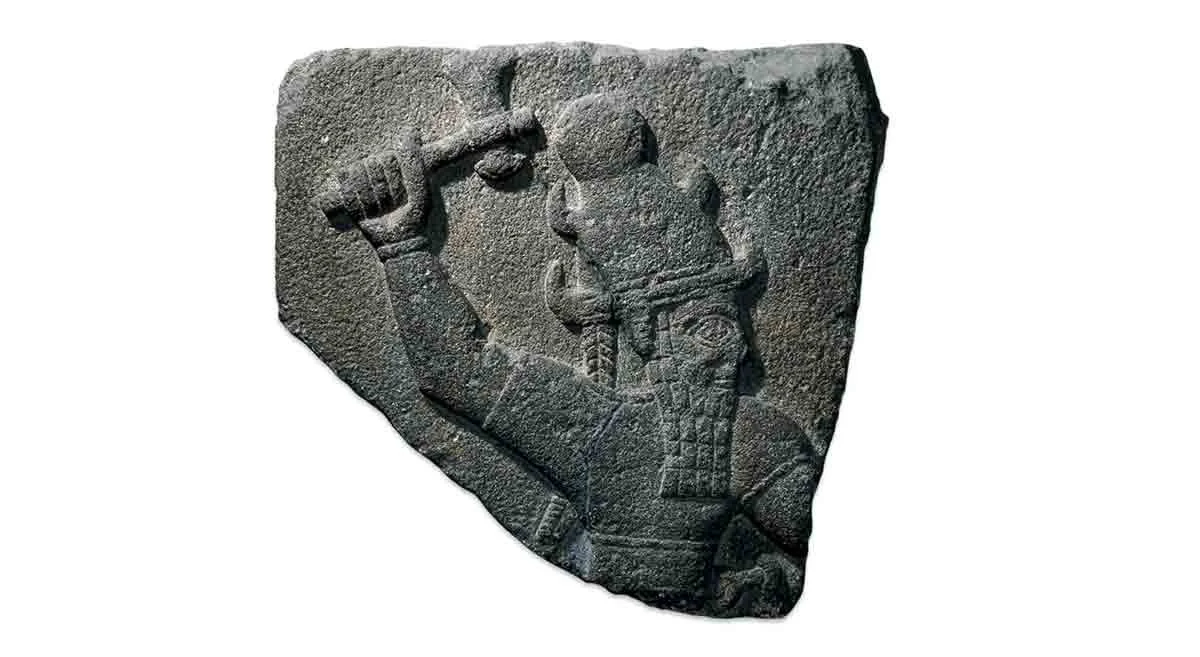
Basalt Relief of Storm God Raising His Hammer, found in King’s Gate, Turkey, c. 10th century BCE. Source: British Museum, London
Hesiod’s stories certainly draw distinctive parallels with these earlier mythologies. As Theogony progresses, Kronos heeds the prophesy that he would be overtaken by his children, the same way he vanquished his own father. Kronos becomes the oppressor, hiding and suppressing his own children as his own father had done. Ouranos may have stuffed the children in a dark cave, but Cronos decidedly swallows them! Rhea puts a stop to this nonsense by offering her husband Kronos a stone in place of her secretly-born child, Zeus. Kronos swallows the stone becoming ill, forcing him to eventually emit his royal descendants, the Olympians.
Here again, as Demetra George[6] points out, we can discern a throughline of stone symbolism through Ninurta, Kumarbi and Kronos – all of whom are agricultural deities living in neighboring regions.
Mythologies Informing our Astrology:
The Babylonians are credited with developing our notion of the zodiac. They observed the path of the Moon across the starry backdrop, detecting the “normal stars” in its path. Eventually, by around the 5th century BCE, twelve standardized zodiac signs were established to connect to their twelve-month calendar. [7]
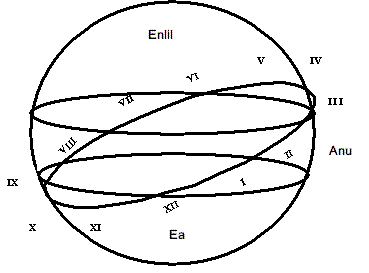
One such sign was Mas, the goatfish. The goatfish was meant to symbolize the Great Ea, the God of wisdom, the seas and the waters. Goat-fish season was associated with the month of Tebetu, also known as the muddy month for its seasonal floods. Mud is the combination of earth and water. Remember that Saturn, or Ninurta, helps to control and direct the waters of Ea.
We also know that Capricorn, the place where the Sun sinks the lowest, is associated with the southern part of the sky attributed to Ea/Enki, ruler of the waters.
Aquarius was referred to as Gu.La, or the Great One. We are told that the Great One also refers to the Sumerian God, Ea. The season of the Great One coincides with the month of Sabatu (which sounds a lot like Saturn’s day, sábado, in Spanish). Sabatu brought a season of rains, storms, and the need to repair crucial infrastructures like canals and irrigation systems.
While the Babylonians may not have explicitly decided which planets rule which signs, they did attribute the planet Saturn to Ninurta.
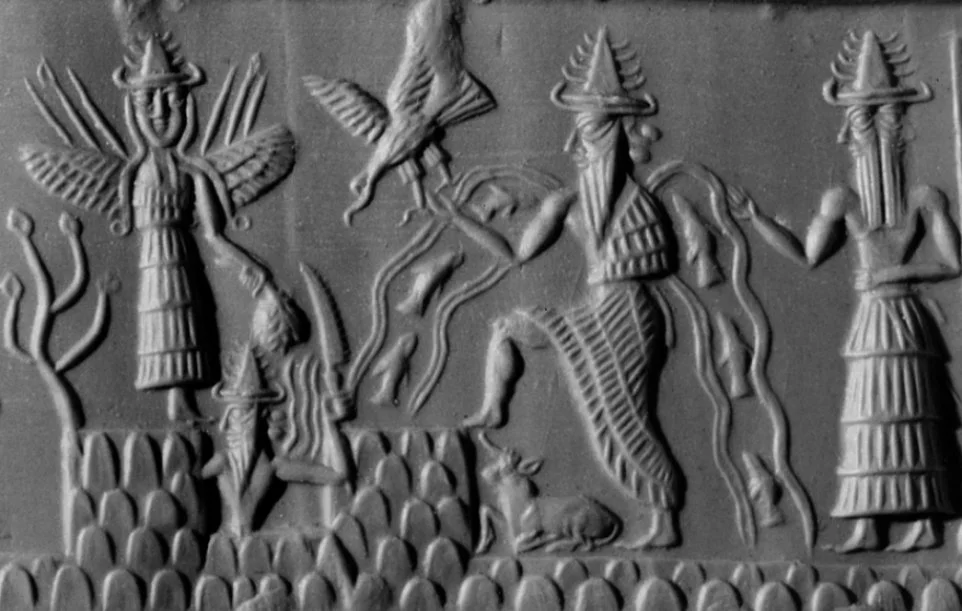
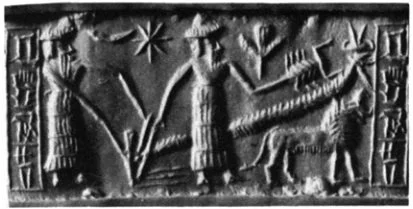
Detail of the Adda Seal, an ancient Akkadian cylinder seal (circa 2300 BCE): Enki with water streams flowing from his body. British Museum.
Note the Capricorn goat at his feat, and the bird on his forearm. At times, Ninurta was depicted with a bird’s head. Here then we see the lower zodiac signs of Capricorn, Aquarius and Pisces.
Chris Brennan theorizes that the system of Hellenistic astrology was formalized around the 2nd century BCE in Alexandria[8]. During this time, we see various core astrological systems emerge, which would define the classical systems of astrology we still revere to this day.
Some of Saturn’s earlier connections to water and farming are clearly evidenced within delineations used by ancient astrologers:
2nd century astrologer, Vettius Valens writes in The Anthology that Saturn “makes serfs and farmers because of its rule over the land, and it causes men to be renters of property, tax farmers and violent in action.” [9]
Two centuries later, astrologer Firmicus Maternus tells us in Mathesis that Saturn in the ascendant by night will give “activities around water,” and in the midheaven by day, “it will make honest farmers […] and those whose possessions are always adjacent to the sea or to rivers or to swamps.”[10]
Abu Ma’shar writes in the 9th century that Saturn “indicates works of moisture, plowing, farming, the masters of villages, the cultivation of lands, wealth and an abundance of assets […], travel on the sea.”[11]
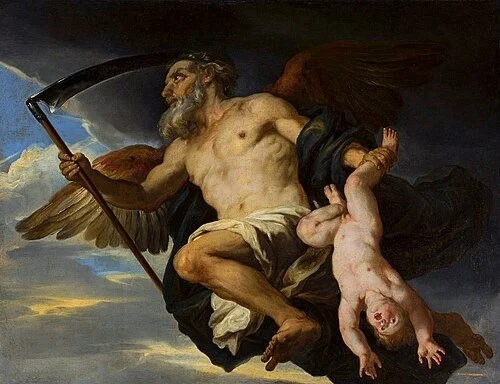
Chronos and his child by Giovanni Francesco Romanelli, National Museum in Warsaw, 17c
But perhaps we can find even more evidence within our classical schemes:
Ninurta, the god of storms and agriculture, would work with Ea, Capricorn to nourish the crops and sustain mankind
Saturn exalts in Libra, the peak season of the harvest
Saturn rules the winter seasons, which according to Ptolemy are cold and wet, akin to the water element.
Saturn rejoices in the 12th house of “bad daimon,” suffering and self-undoing. Ninurta was also a deity who could heal and expel demons.
In the Thema Mundi, Saturn’s exaltation, Libra is on the 4th house, the place where water sinks the lowest, according to Aristotle.
In the Planetary Spheres scheme, the starry realm of Ouranos sits above the sphere of Saturn, which then sits above Jupiter, telling a story of cosmic succession.
Capricorn, Saturn’s domicile and Mars, the God of war, exaltation may allude to Ninurta’s dual nature as warrior and agricultural deity
The third decan of Taurus is ruled by Saturn. The Taurus decans relate very much to farming, and I wonder if there is more to explore here.
Saturn’s astrological glyph appears like a sickle (♄)
(Can you think of any others??)
In Summary:
For years I wondered about these occulted watery connections shared by the Saturn-ruled signs. It took me years to piece all of this together – not to mention the blessing of living through the blossoming of our very own contemporary astrological renaissance. Never before has quality astrology been so freely shared and so widely accessible from anywhere in the world. Truly, I could not have answered these questions until I dove into the ancient source texts. The astrological tradition has factually preserved Saturn, or Ninurta’s earlier connections to farming, irrigation and the management of waters. The Greek incarnation of Kronos may have retained a strong connections to the waters, but at least he has kept his sickle!
Do you have a prominent Saturn in your chart? Let’s connect!
Big Blessings,
Catherine
Bibliography:
[1] THE GOD NINURTA. In the Mythology and Royal Ideology of Ancient Mesopotamia. By. Amar Annus. THE NEO-ASSYRIAN TEXT CORPUS PROJECT. 2002
[2] Wikipedia article on Lugal-e
[3] The Astrology Podcast: Origins of Planetary Myths in Astrology
[4] Hesiod. (1988). Theogony and Works and Days, a new translation by M.L. West. Oxford: Oxford World Classics.
[5] https://www.thecollector.com/kumarbi-cycle-hurrian-myth/
[6] The Astrology Podcast: Origins of Planetary Myths in Astrology
[7] Rochberg, F. (2004). The Heavenly Writing. New York: Cambridge.
[8] The Astrology Podcast: The Origin of the Chaldean Order and Planetary Days of the Week
[9] Valens, V. (2022). The Anthology, translated by Mark T Riley. Denver: Amor Fati.
[10] Maternus, J. F. (2011). Mathesis, translation from latin by James Herschel Holden. Tempe: American Federation of Astrologers.
[11] Ma'shar, A. (2020). The Great Introduction, translated by Benjamin N Dykes, PhD. Minneapolis: The Cazimi Press.